Your Brand Isn’t Lazy. But Your AI Use Might Be.

When everyone uses the same prompt and calls it strategy, the only thing they’ve automated is mediocrity.
There’s a flyer making the rounds on social media right now. Bold text. Chaotic layout. AI-generated glow effects. Details so ridiculous they’ve become the joke: “February 30th.” Venue not announced. Time listed as “4–?” Tickets priced at $26 with a can of soup. And at the bottom, in the same font as everything else: “Ain’t nobody reading all that garbage.”
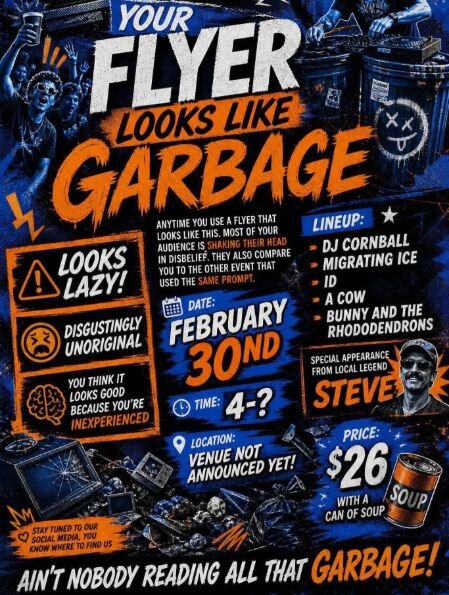
The flyer wasn’t a mistake. It was satire. And it landed because every marketer, designer, and business owner recognized it immediately.
We’ve all seen that flyer.
Some of us have even had a client send it over and say, “Can we do something like this?”
Here’s the uncomfortable truth: AI didn’t make that flyer bad. The decision to approve it did.
The Strategic Gap Nobody Wants to Talk About
We’re having the wrong conversation about AI. Most debates focus on AI versus human creativity, as if the tool itself is the problem. It isn’t. The real question is whether you’re using AI to accelerate thinking or replace it.
The biggest mistake I see businesses making right now isn’t using AI. It’s outsourcing judgment to it. They’re letting AI define their visual identity. They’re letting AI determine how they communicate with customers. They’re letting default outputs become default branding.
And every time that happens, they lose a little more differentiation. Because when you accept whatever comes back from a prompt without applying strategy, you haven’t saved time. You’ve spent trust.
Everyone is using the same tools. The businesses that stand out are the ones making better decisions, not generating more content.
Same Prompt. Same Brand.
Here’s what’s happening in the market.
Thousands of businesses are running slight variations of the same prompts. The same visual styles. The same copy formulas. The same “attention-grabbing headline, supporting text, call-to-action” framework. The same generic energy that used to come from stock photos and now comes from AI-generated graphics.
Your audience may not know why something feels familiar, but they know when it does. They’ve already seen that design. They’ve already read that caption. They’ve already heard that voice. Not from you. From everyone else. And that’s the problem.
Brand equity is built through specificity. It’s built through choices. It’s built when people can recognize your business before they see your logo. The moment your marketing becomes indistinguishable from everyone else’s, you stop building a brand and start producing content.
Those are not the same thing.
What Intentional AI Use Actually Looks Like
I use AI every day. Not because it replaces expertise. Because it removes friction. Used correctly, AI speeds up ideation, shortens production cycles, and helps teams move faster. But speed is not strategy. AI can generate options. You choose the direction. AI can write a first draft. You decide whether it sounds like your company. AI can build Version One. You are responsible for Version Final. That’s the distinction too many businesses miss.
The companies that will win over the next five years won’t be the ones using AI the most. They’ll be the ones using it with discipline. The ones that start with a clear brief. The ones that have standards. The ones that understand the difference between output and positioning.
Three Questions Before You Publish Anything
Before you post the next AI-generated graphic, ad, email, or flyer, ask yourself:
1. Does this look like something only our brand would create?
2. Did a human make meaningful decisions, or did we accept the default?
3. Would we approve this if it came from a junior designer?
That third question tends to reveal everything. Because if the answer is no, the work isn’t finished. AI got you to Version One. That’s what it’s supposed to do. Your job is to make sure Version One doesn’t become Version Published.
The viral flyer had all the ingredients. The problem wasn't the tool. It was that nobody in the room asked, "Is this us?"
That's the only question AI can't answer for you.